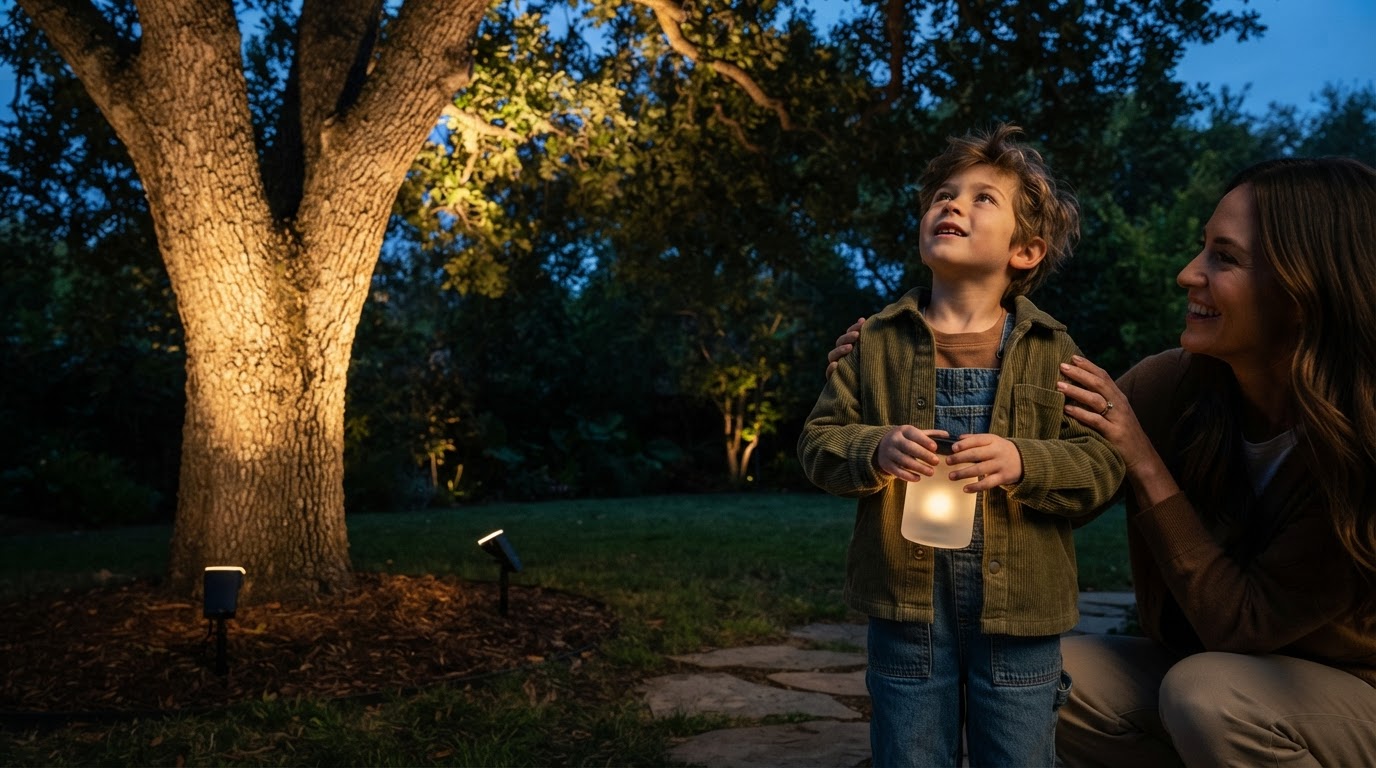
Smart Solar Spotlight Tree Illumination Strategy
 Maya ChenContributing Editor
October 19, 2026 — The industry shift toward high-lumen wireless systems has placed Smart Solar Spotlight at the center of a debate regarding effective vertical illumination. While the market pushes for higher bulb counts, the reality of lighting large arboreal features requires a more disciplined approach to beam angle and ground-to-canopy clearance.
The conventional wisdom says that any high-output floodlight can serve as a tree accent, but this ignores the physics of light dissipation over distance. According to data from EarthTech Products, professional-grade solar spotlights are now reaching price points of $159.00 for dedicated wireless remote units, reflecting a demand for precision over raw power. For most residential applications, the failure point isn't the battery capacity, but rather the physical positioning of the hardware relative to growing foliage. If a fixture is buried in the grass, the lower trunk absorbs the majority of the output, leaving the canopy in total darkness.
The Height and Lumens Protocol
Here's the part nobody talks about: most solar fixtures fail because they are physically too short to clear the surrounding ground cover. To achieve a clean throw of light into a tree's secondary branches, the light source must be elevated. T-SUN Lighting has addressed this by utilizing extension arms that bring the total height to 44 cm, ensuring the solar panel remains above the grass line to maintain a consistent charge. When integrating a wireless solar spotlight for trees, the math usually dictates a minimum of 300 to 1,000 lumens for a 20-foot canopy. Systems like the Jackyled LED Outdoor Solar Flood Light, cited by Forbes Vetted, utilize nearly 300 LED bulbs to hit that 1,000-lumen threshold, which is the baseline for overcoming the ambient light pollution found in suburban environments. For those utilizing rgbw smart solar landscape lighting, the challenge doubles; you are no longer just fighting darkness, but managing color saturation. If your smart solar spotlight for precise RGBW color mapping isn't positioned at an optimal 45-degree upward angle, the chromatic effect is lost to the soil. Effective rgbw smart solar landscape lighting requires a clear line of sight to the trunk's mid-section to allow the light to bleed naturally into the upper leaves.
Expert tip: Run the math on your foliage density before purchasing; a dense evergreen requires twice the lumen output of a deciduous tree with a thin branch structure to achieve the same visual depth. I'll change my mind when manufacturers prioritize adjustable beam widths over sheer bulb count, as a narrow 15-degree beam is far more effective for tall palms than a generic 120-degree flood.
Sources
- Solar Spot Lights & Solar Flood Lights - EarthTech Products
- TSUN Solar Spotlights For Trees Warm White - T-SUN Lighting
- You Won't Believe These Yard Lights Are Solar Powered - YouTube