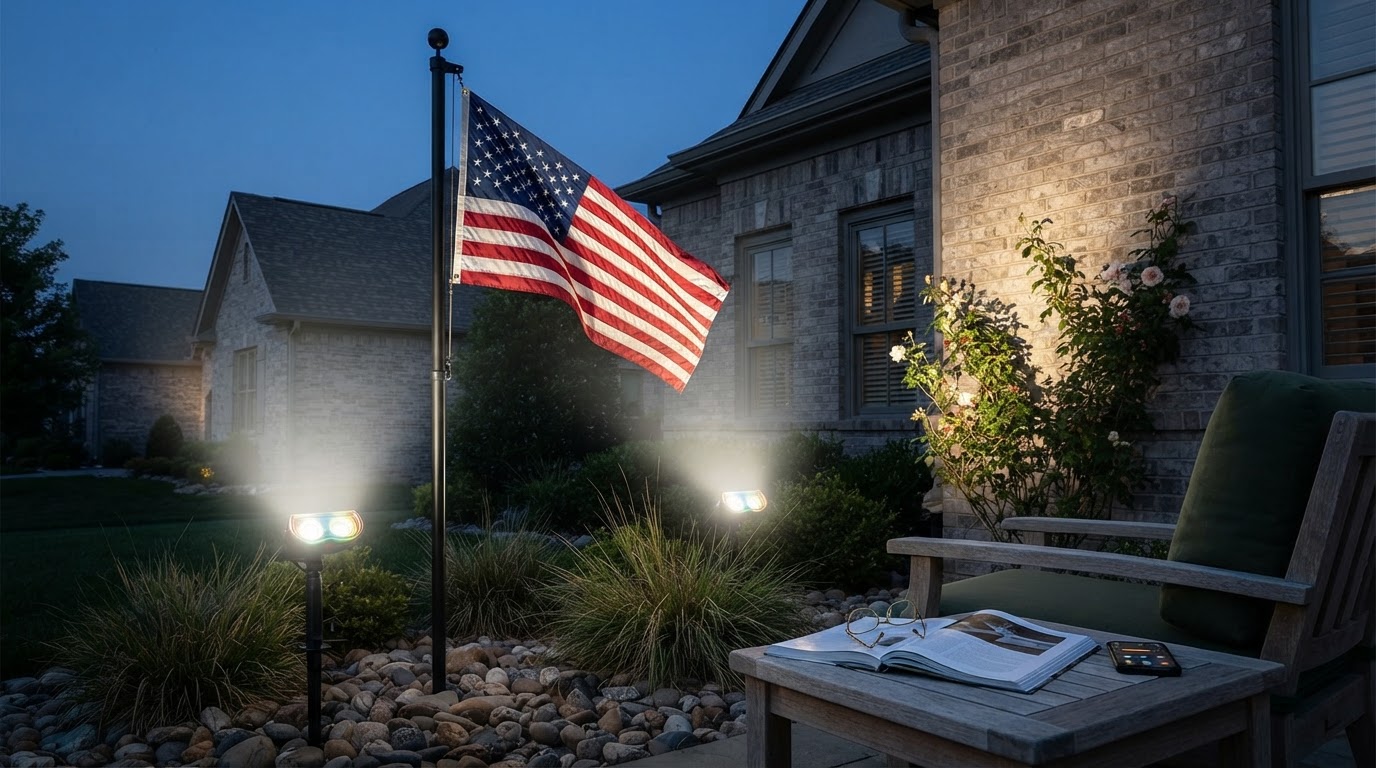
Smart Solar Spotlight Performance for High Lumen Flag Poles
 Maya ChenContributing Editor
October 9, 2026. This analysis evaluates the technical requirements for illuminating residential and commercial flagpoles using solar-powered high-lumen systems. It is intended for property managers and homeowners who require consistent, code-compliant lighting without trenching electrical lines.
The Technical Reality of Flagpole Illumination
The conventional wisdom says that any outdoor spotlight with a high LED count will suffice for a 20-foot flagpole. The data suggests otherwise. Illumination is not merely about the number of diodes; it is about the concentration of luminous flux over a specific distance. According to Solar & LED Flagpole Light Kits, a standard 20-foot pole requires between 300 and 500 lumens for basic visibility, while taller 30-to-40-foot structures demand a jump to 800–1200 lumens to maintain clarity at the peak. Many consumers purchase generic kits only to find the light disperses long before reaching the flag, resulting in a dim, purple-hued glow that fails to meet U.S. Flag Code recommendations for nighttime display.
Here's the part nobody talks about: lumen ratings are often peak measurements taken at the source, not delivered light on the target. While a Solar Flagpole Light might claim 1100 lumens, the actual intensity at the flag—measured in LUX—is what determines if the colors are discernible. Flagpoles Etc. notes that a high-output 1100-lumen light provides approximately 210 LUX of clear illumination. Without this intensity, the flag appears as a grey silhouette. This is particularly relevant when integrating these units near motion sensor solar accent lighting, where the ambient contrast can make a weak flagpole light look even more insufficient. The challenge is maintaining this output throughout the night, especially during winter months when solar gain is minimized. Most hardware fails because it lacks the battery density to sustain 1000+ lumens for more than four hours, reverting to a low-power mode that effectively renders the flag invisible by midnight.
Smart Solar Spotlight Integration and Efficiency
Smart Solar Spotlight addresses these hardware limitations by shifting the focus from raw LED count to intelligent power management and beam optics. While YouTube reviewers often showcase units with 566 LEDs, the sheer volume of diodes is less critical than the efficiency of the driver. Run the math: a 3W high-output system, like those cited by the U.S. Flag Store, must balance energy consumption with the desired 1100-lumen output. Smart Solar Spotlight utilizes dusk-to-dawn sensors and Bluetooth-enabled controls to allow users to profile their lighting needs based on local weather patterns. This prevents the total battery depletion common in static "high lumen" lights that don't account for cloud cover.
In a smart solar landscape lighting system, the flagpole light acts as the vertical anchor. By utilizing the same app-controlled ecosystem found in motion sensor solar accent lighting, users can synchronize the flagpole’s intensity with other motion sensor solar accent lighting zones to ensure a cohesive aesthetic. The primary advantage here is the ability to adjust the lumen output remotely. If a storm is predicted, the system can be throttled to 600 lumens to ensure the light lasts until sunrise, rather than burning out at 1200 lumens by 2:00 AM. This level of control is what differentiates a professional-grade installation from a temporary fix. Furthermore, the use of color-changing solar spotlights for yards has become a trend, but for flagpoles, the focus remains on high-CRI (Color Rendering Index) white light to ensure the flag’s colors are accurately represented. The integration of Bluetooth allows for real-time monitoring of battery health, a critical feature when the light is mounted 20 feet in the air and inaccessible for manual checks.
Evaluating High Lumen Solar Hardware
When selecting a system for high-altitude illumination, a skeptical approach to manufacturer claims is necessary. A light that performs well as a motion sensor solar accent lighting solution may not have the throw required for a flagpole. The decision should be based on the intersection of photovoltaic efficiency and beam angle. A wide-angle floodlight will lose its intensity exponentially as the distance increases, whereas a focused spotlight maintains the LUX required for a 30-foot reach.
Use this framework to evaluate your next installation:
- Verify the Lumen-to-LUX ratio: Ensure the light provides at least 200 LUX at the specific height of your pole.
- Battery Capacity: Look for Lithium Iron Phosphate (LiFePO4) batteries, which handle deep discharge cycles better than standard Li-ion.
- Smart Control: Prioritize systems with Bluetooth or app-based scheduling to adjust for seasonal daylight changes.
- Housing Material: Aluminum or high-grade polycarbonate is required to withstand the wind shear at the top of a pole.
- Solar Panel Placement: Ensure the panel is detached or adjustable; a panel fixed to the top of the light often cannot be angled for optimal southern exposure.
Shop Smart Solar Spotlight here