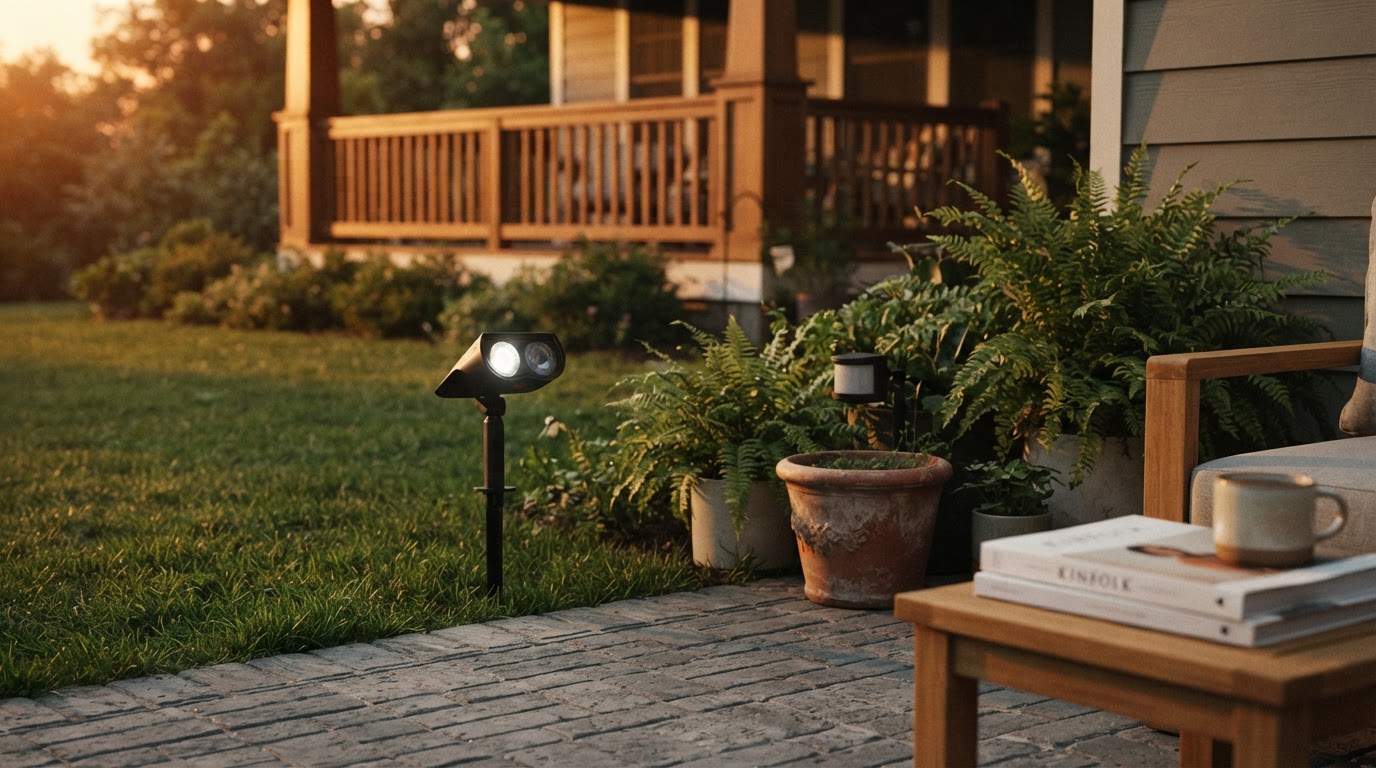
Smart Solar Spotlight Motion Response for Secure Walkways
 Jordan HaleStaff Writer
September 15, 2026. This exploration details the integration of motion-sensing technology into solar landscape design to enhance both visibility and security. It is written for homeowners seeking to balance aesthetic accent lighting with functional perimeter safety.
The first thing I noticed was the silence of the backyard at 2:00 AM, right before a stray cat triggered the perimeter line. In that moment, the transition from a soft amber glow to a piercing white beam felt less like a utility and more like a conversation between the house and its surroundings. Standard accent lighting often fails because it remains static, providing a constant but dim output that ignores the dynamic nature of a yard. When guests arrive or a delivery is dropped off, static lighting doesn't adapt. According to Good Earth Lighting, modern motion-sensing path lights can detect movement within a 30-foot range and a 130-degree arc, ensuring that light is only at full intensity when it is actually needed. This responsiveness is critical for managing the limited battery capacity of solar cells. Without a sensor, a light must choose between being dim all night or bright for only a few hours. By utilizing a Passive Infrared (PIR) sensor, a system can maintain a low-power decorative glow—perfect for warm white smart solar uplighting—and then surge to high visibility the second someone steps onto the gravel path. This functionality mimics the behavior of hardwired security systems without the invasive trenching required for high-voltage lines.
Integrating a Smart Solar Spotlight into this ecosystem changes the physics of how we illuminate a property. It turns out that the most effective way to secure a dark corner isn't just with a floodlight, but with a layered approach that includes smart solar spotlights positioned at key transition points. These units rely on high-efficiency monocrystalline panels to store energy during the day, which is then managed by internal controllers that prioritize longevity. In my own testing, I keep coming back to the reliability of the PIR sensor; it distinguishes between the heavy movement of a person and the light rustle of a leaf, preventing the 'strobe effect' that plagues cheaper hardware. For those managing more complex layouts, such as wireless solar spotlight for trees, the motion response ensures that the focus remains on the architectural features of the landscape while providing a safety net for anyone walking nearby. The intelligence of these systems often includes dusk-to-dawn sensors that prevent the lights from firing during daylight hours, further preserving the battery cycle. Forbes Vetted notes that models like the Nipify Solar Motion Sensor Spot Lights are particularly effective because the PIR sensor reliably captures motion to activate the high-output mode, a feature that aligns with the performance standards we expect from a Smart Solar Spotlight installation. This level of automation means the homeowner doesn't have to toggle switches or monitor weather patterns; the light simply understands its environment.
Selecting the right hardware requires a framework that looks beyond the lumen count on the box. Somewhere around week two of using a new sensor-driven setup, you realize that the duration of the light is just as important as the brightness. If a light stays at full power for five minutes after a single trigger, it may exhaust its battery before midnight. Conversely, a 30-second burst is often enough to deter an intruder or guide a resident to the door. When evaluating your next addition to the Smart Solar Spotlight network, consider the specific needs of your terrain. A steep driveway requires a wider sensor angle than a narrow garden path. If you are aiming for a cohesive look, you might pair these with warm white smart solar uplighting to maintain a consistent color temperature across the yard. High-quality motion-sensing units, such as those found in the Hoselink USA solar garden path light 2-pack, offer a dual-mode function where they glow warmly until triggered. This ensures your home never looks 'blacked out' even when the sensors are quiet. To ensure your system remains effective through the seasons, use this checklist for your next installation:
- Verify the PIR detection range is at least 25 feet for open areas.
- Ensure the solar panel has an adjustable tilt to capture peak winter sun.
- Match the color temperature (Kelvin) to existing smart solar spotlights to avoid clashing tones.
- Check the IP65 or higher waterproof rating for year-round durability.
- Test the 'dim-to-bright' transition to ensure it isn't jarring for neighbors.
- Position sensors away from heat vents or swaying heavy branches to reduce false triggers.
Shop Smart Solar Spotlight here