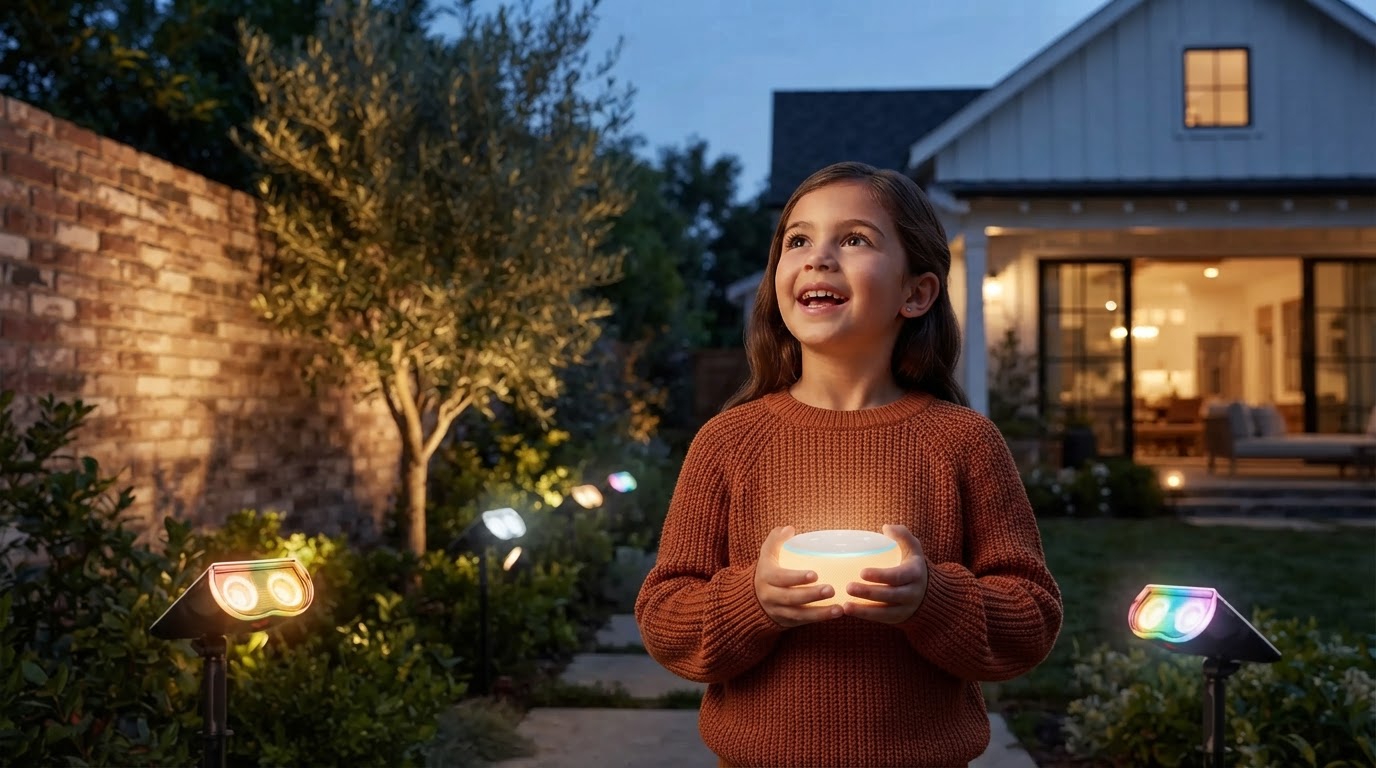
Smart Solar Spotlight Alexa Integration Strategy
 Maya ChenContributing Editor
August 11, 2026—The trend toward voice-controlled exteriors has reached a tipping point, with Smart Solar Spotlight now central to the discussion of hands-free garden management. While the market pushes for total automation, the reality of solar-powered hardware meeting cloud-based voice assistants often reveals technical friction that most reviewers ignore.
The conventional wisdom says that voice control is the peak of convenience for modern yards, yet Nanoleaf notes that many users still rely on dedicated remotes or daylight sensors to manage up to 20 lights simultaneously because of the inherent latency in Wi-Fi-to-solar bridges. This skepticism is well-founded; when a device relies on a battery charged by the sun, maintaining a persistent 2.4GHz connection for "always-on" Alexa listening can be a significant drain on power reserves that should be reserved for illumination.
The Three-Step Integration Protocol
To successfully bridge a Smart Solar Spotlight system with Amazon Alexa, the hardware must first be registered within its native proprietary application. This creates a secure handshake between the local Bluetooth or Zigbee signal and the cloud server. Once the device is visible in the smartphone interface, the user must enable the corresponding manufacturer skill within the Alexa app. The final step involves discovery, where Alexa scans the network to assign the spotlight to a specific "Room" or "Group." Run the math: each additional step in this digital handshake introduces a potential point of failure. While the hardware itself is designed for durability, the software layer requires a stable bridge—typically a dedicated hub—to translate Alexa's cloud commands into the low-energy signals solar lights use to preserve battery life. For those pursuing diy smart hardscape lighting solar, this bridge is often the most overlooked component. The current technical standard for these units focuses on high-efficiency output, with users frequently searching for smart solar spotlights that balance 4800 impressions worth of tree-lighting power with the 2900 impressions of demand for system-wide landscape control. Integrating these into a broader plan for optimizing landscape design with Smart Solar Spotlight requires acknowledging that voice commands are a secondary interface to the primary dusk-to-dawn sensors.
Expert tip: To prevent battery exhaustion, set Alexa routines to trigger Smart Solar Spotlight units at 50% brightness during voice-activated periods, reserving full power for motion-detected events or manual overrides.
Here’s the part nobody talks about: voice control is often slower than a physical sensor. I'll change my mind when latency drops below 100 milliseconds across all solar-mesh networks without compromising the 12-hour runtime typical of these units.
Sources
- Automate your outdoor lighting | Smart Home | Amazon Alexa
- Control Landscape Lights with Amazon Alexa, your ...
- Solar Garden Lights