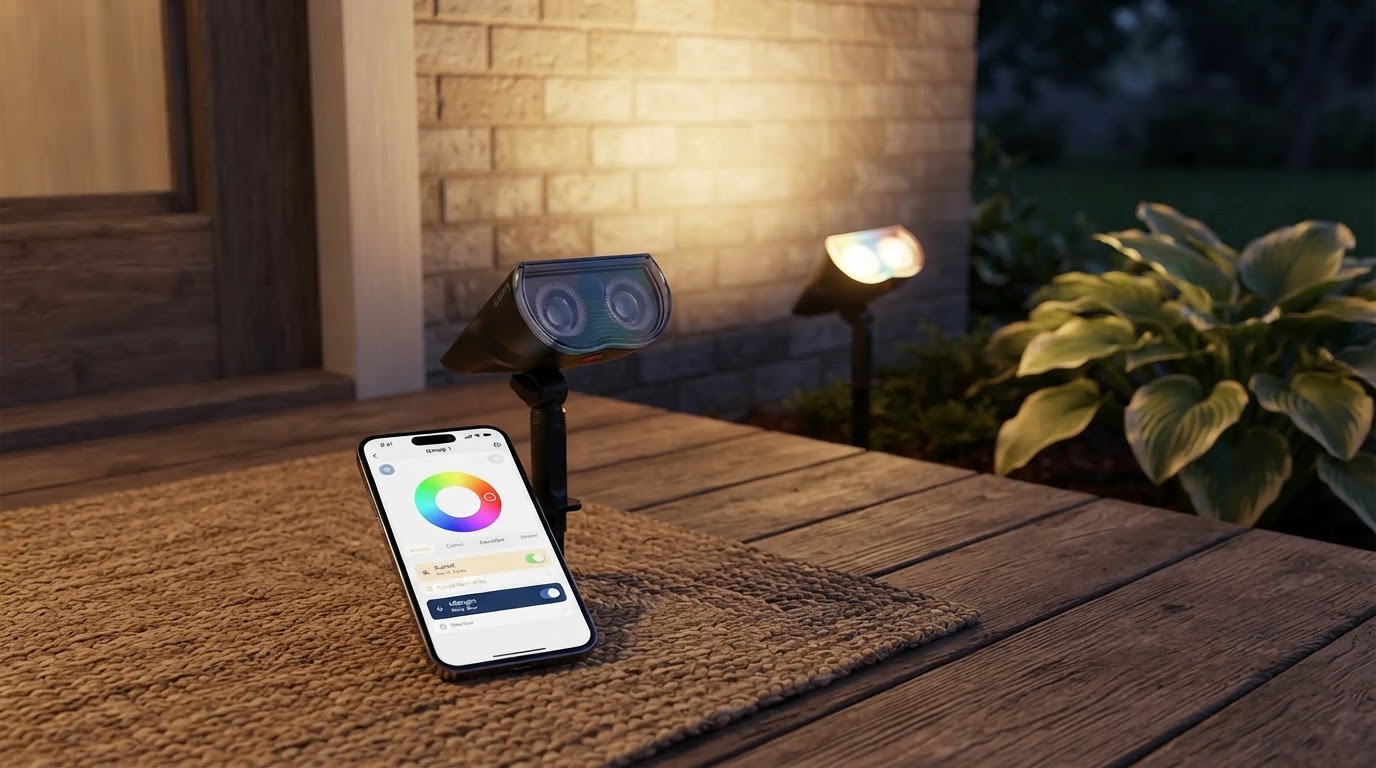
How do Smart Solar Spotlight apps control yard lighting?
 Maya ChenContributing Editor
August 5, 2026 — App-controlled solar landscape lights utilize low-energy Bluetooth or proprietary Wi-Fi bridges to synchronize localized hardware with smartphone interfaces, allowing for granular scheduling and color adjustments that traditional photocells cannot achieve.
The conventional wisdom says that solar lighting is a 'set and forget' technology defined by simple dusk-to-dawn sensors, yet the rise of integrated ecosystems like AiDot suggests a shift toward active management. Property owners are increasingly seeking the precision of hardwired systems without the infrastructure costs, driving the adoption of Bluetooth-mesh enabled fixtures for trees and pathways.
How does Bluetooth connectivity impact solar light performance?
Bluetooth connectivity allows solar lights to transcend the limitations of physical switches, though it introduces a dependency on signal proximity that many users underestimate. According to the Solar Lighting app documentation on the Apple App Store, the interface provides six primary control buttons, including a dedicated ON/OFF toggle and timer settings that bypass the default hardware logic. While this adds convenience, the hardware must maintain a battery reserve specifically for the Bluetooth radio, which remains active even when the LEDs are dark. This constant power draw is the part nobody talks about; in low-sunlight conditions, a 'smart' light may deplete its reserves faster than a 'dumb' light simply by waiting for a command. Evidence from Linkind product specifications indicates that these units are designed to handle this overhead through high-efficiency monocrystalline panels, but the trade-off between connectivity and total runtime remains a fixed technical constraint.
Can app control improve the aesthetics of solar spotlights?

Photo by Jeric Turga on Pexels
App control shifts the aesthetic utility of solar spotlights from static illumination to dynamic design, provided the user manages the software overhead. Instead of fixed lenses, systems like the Linkind SP6 Smart Solar Pathway Lights utilize the AiDot app to manage color-changing sequences and brightness levels across multiple zones simultaneously. Run the math: a standard solar light offers one Kelvin temperature, whereas the SP6C model supports millions of colors and includes five swappable lenses to physically alter the beam pattern. A review by the channel 'Is SOLAR the Future of Smart RGBW Outdoor Lighting?!' highlights that this software integration allows solar fixtures to mimic high-end wired RGBW systems, which historically required expensive transformers and controllers. However, the effectiveness of these aesthetics is entirely dependent on the stability of the Bluetooth mesh; if one unit in the chain fails to sync, the visual cohesion of the yard is compromised.
Quick answers
Q: Do app-controlled solar lights work without a smartphone? A: Most units, such as those in the Linkind series, will default to a standard dusk-to-dawn cycle using their internal light sensors if no app connection is detected. However, advanced features like specific RGB color selection or custom timers will be inaccessible until a Bluetooth link is established.
Q: What is the typical range for controlling these lights via an app? A: Standard Bluetooth-enabled solar spotlights generally require the user to be within 30 to 50 feet of the fixture to initiate a command. For larger properties, systems that support mesh networking allow one light to pass the signal to the next, effectively extending the control range across the entire installation.
Q: Can I schedule different lights to turn on at different times? A: Yes, through apps like AiDot or Solar Lighting, users can group fixtures into specific zones and assign unique schedules to each. This allows for high-traffic areas like driveways to remain illuminated longer than decorative accents on trees or garden beds.
I'll change my mind when manufacturers move away from proprietary apps and adopt a universal, open-source standard for solar-specific mesh networking that doesn't require a cloud account for basic local operation.
For further technical details, see our analysis of Smart Solar Spotlight App Control Strategies and the benefits of Outdoor Solar Spots With Bluetooth. For those focusing on color dynamics, explore Smart Solar Spotlight App Control for Modern Yards.
Learn more about Smart Solar Spotlight at https://smartsolarspotlight.com.
Sources
Photo by Anna Klymenko on Pexels
- Linkind SP6 Smart Solar Pathway Lights - AiDot
- Solar Lighting - App Store
- Best Smart solar lights?! My FULL Review: AiDot Linkind ... - YouTube