
How Many Solar Spotlights Do You Need? A Landscape Pack Size Selection Guide
The number of solar spotlights a landscape needs is the number of distinct subjects you can hit from 5-7 feet with a sunlit panel, not a rule of thumb per 100 square feet. Use the Linkind SL5C Smart Solar Spotlight as a 350-lumen building block: one for each path segment, bed, tree, or hardscape face, staggered on walks, never two on the same shrub. Subtract shade. The remaining count is the landscape pack.
Zone first, then count fixtures inside each zone
Draw four lists: circulation (walks and steps), planting (beds and specimens), canopy (trees worth uplighting), and hardscape (walls, fences, water bowls that are not submerged fixtures). Each list is a set of beams. Mixing them in one mental pile is how yards end up with eight lights on the patio and a black side yard.
Circulation wants a staggered path lighting approach for uniform illumination. Planting wants side light or grazing, still at 5-7 feet. Canopy wants the stake in sun, the head aimed up the trunk. Hardscape wants a grazing angle that shows texture, not a lamp parked on the cap of the wall.
The guide to optimizing landscape design with smart solar spotlights is the design companion to this count.
One subject, one 350-lumen beam
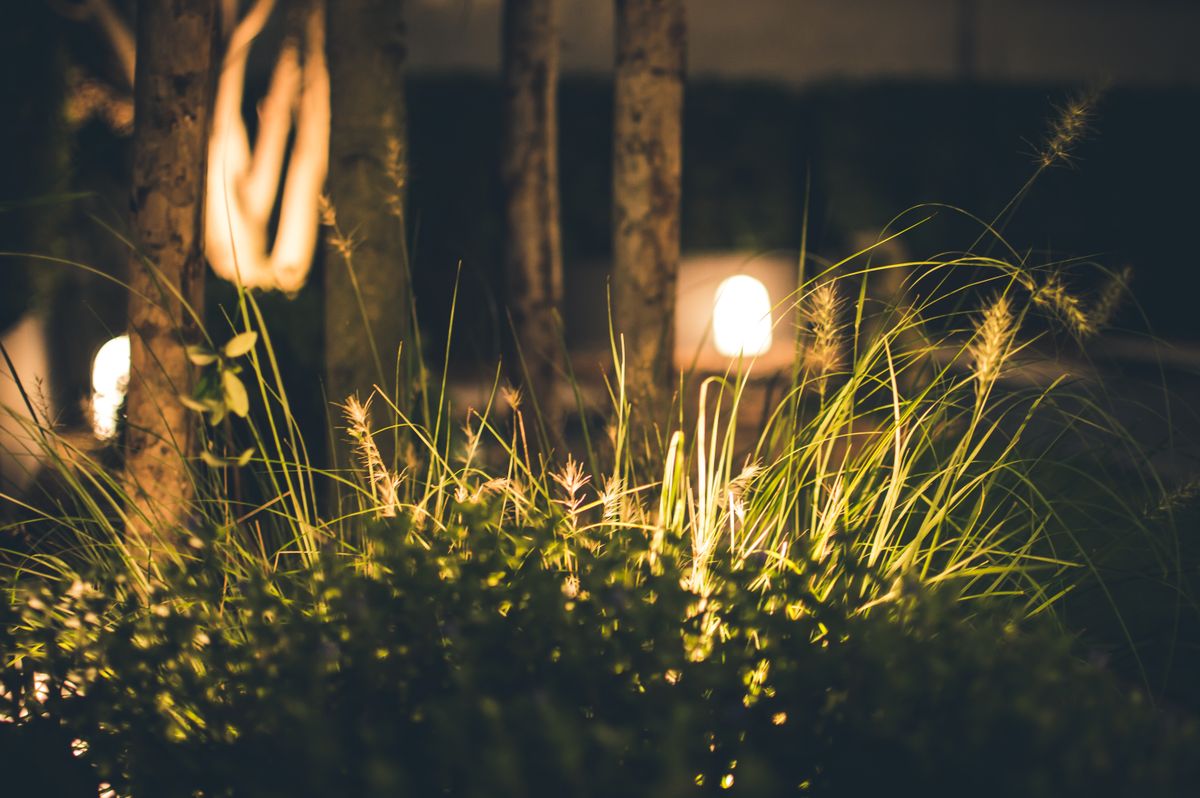
Photo by suzukii xingfu on Pexels
350 lumens is an accent. Two SL5C units on one hydrangea do not make a hydrangea twice as designed; they make a hot blob. Move the second fixture to the next plant or to the path that people actually trip on.
Trees are the exception people over-buy. A mature canopy may take two fixtures on opposite sides if both panels see sky and both sit near 5-7 feet from the trunk or lower limb. If the canopy is dense enough to shade both panels, it is a poor solar subject. Pick a different tree or a wall.
RGBTW does not multiply coverage. Plan the night in white first. Color scenes in Aidot 2.5.0 can ride on that same layout later.
Gaps versus overlap
A dark band between two path lights is a missing fixture or a stagger that is too wide, not a reason to raise brightness until the cell dies early. Runtime is 8-12 hours; blasting every lamp at full RGB party mode is how a landscape pack goes dark before closing time.
Overlap on purpose only at turns and steps. Those are the hazard points. Overlap on a flat open lawn is wasted pack size.
IP67 lets the count live outdoors through rain. It does not let a panel hide under a bench. If the design wants an invisible source, the panel still has to see the sky.
A worked landscape count
Example: a rear yard with a 40-foot paver walk, two beds, one maple, a seating wall, and a dark side-yard gate. Walk: three staggered spots. Beds: two. Maple: one or two if both panels charge. Wall: one graze. Gate: one. That is eight to ten, then minus any that sit in the maple's own shadow.
Do not add a fixture for every plant in a bed. Light the bed as a mass from 5-7 feet, or light the one specimen that carries the bed. DIY install at $0 estimated cost means the limit is aiming time.
Landscape zones and a starting fixture count
| Zone | How to count | Do not count | | --- | --- | --- | | Path and steps | Staggered spots along the route, extra at landings | One lamp at the start of a long walk | | Planting beds | One beam per bed or specimen | One lamp per perennial | | Trees | One, or two opposite, if both panels see sky | A shaded grove as a solar cluster | | Hardscape | One graze per face or corner | A lamp sitting on top of the wall cap | | Side yard / gate | One if the panel can charge | A north alley with no sky |
Night budget is per fixture, not per pack
Each SL5C stores its own day of sun and spends 8-12 hours. A ten-light landscape is ten charge problems. One shaded underperformer does not drain the others, which is why solar packs scale without a transformer. It is also why you cannot steal runtime from a sunlit lamp to rescue a shaded one.
Adjustable brightness in the app is how a large pack stays even. Dim the close path lights; leave the far tree a bit higher. Music sync is for hours people are actually outside. Solar powered with no extra electric cost is the operating story; the design story is still the zone list.
Landscape pack-size checklist

Photo by Alexas Fotos on Pexels
- [ ] Split the yard into path, bed, tree, and hardscape lists.
- [ ] Put one 350-lumen job at 5-7 feet on each subject.
- [ ] Stagger the path; overlap only at steps and turns.
- [ ] Delete any zone that cannot put a panel in open sky.
- [ ] Count remaining jobs; that number is the pack.
- [ ] Aim and pair in Aidot 2.5.0 before ordering a second wave.
Frequently asked questions
Is there a fixtures-per-square-foot rule?
No. Count subjects at 5-7 feet with sunlit panels. Area formulas over-buy lawn and under-buy steps.
How many lights for a typical suburban backyard?
Often six to ten once paths, one tree, beds, and a wall are listed and shade is subtracted. Walk the yard; do not copy a number.
Should every plant in a bed get a spotlight?
No. Light the bed as a mass or light one specimen. Personal lamps for every perennial waste the pack.
Can I use fewer lights if I turn brightness up?
Not really. 350 lumens still has a 5-7 foot working distance. Brightness does not replace a missing zone.
Do solar packs need a bigger transformer as they grow?
No. Each fixture is solar powered. Growth is more panels in the sun, not more wattage at the house.
Related reading
Landscape design, mature trees, and backyard idea pages sit beside this count.
- enhancing landscaping with a smart solar spotlight
- selecting smart solar spotlights for mature trees
- outdoor smart lighting ideas for backyard spaces
What to do next
Sketch four zones on a scrap of paper: path, bed, tree, hardscape. Write one 350-lumen job per subject at 5-7 feet, stagger the walk, and cross out shade. The leftover number is how many Linkind SL5C spotlights the landscape actually needs. Install that set, then judge leftover dark pockets on night two.
Cover photo by Alexas Fotos on Pexels.