Smart Solar Spotlights vs. Hardwired Floodlights for Home Perimeter Defense
Should you install hardwired floodlights or smart solar spotlights for home perimeter defense? Smart solar spotlights are the superior choice for most residential perimeters. They eliminate high electrician installation fees, cost $0 in ongoing grid electricity, and allow flexible multi-point placement (5–7 feet setback) that eliminates the severe blind-spot shadows inherent to single hardwired floodlights.
Scenario-Based Comparison: Smart Solar vs. Hardwired Floodlights
| Property & Security Scenario | Hardwired Floodlight Performance | Smart Solar Spotlight Performance | Winning Solution & Key Reason |
| --- | --- | --- | --- |
| 100+ Ft Perimeter Fence Line | Failure Mode: Trenching conduit costs $1,200–$2,500; rigid single placement leaves unlit dark zones between lights. | Staggered multi-point setup delivers continuous border coverage; $0 trenching labor and $0 electric bill. | Smart Solar Spotlights — Eliminates massive upfront electrical trenching and labor costs. |
| Landscaped Fence with Sheds & Obstacles | Failure Mode: Casts intense single-source glare and long, deep blind-spot shadows behind structures. | Multi-fixture fill lighting placed 5–7 ft back illuminates behind obstacles with zero dark corridors. | Smart Solar Spotlights — Superior security coverage via multi-angle shadow elimination. |
| Dense Northern Tree Canopy (<3 Hrs Direct Sun) | Continuous 120V grid power guarantees high peak lumens regardless of tree cover or weather. | Failure Mode: Solar panel starvation leads to reduced night runtime if daylight is permanently obstructed. | Hardwired Floodlights — Grid power overcomes permanent, heavy canopy shade. |
| Smart Home Automation & Scene Tuning | Requires expensive hardwired smart switches or relays; restricted to static single-color temperature. | Native Aidot app (v2.5.0) control, RGBTW color changing, custom scheduling, and music sync. | Smart Solar Spotlights — Dynamic app-based security automation without extra wiring. |
Compare how hardwired and smart solar solutions perform under demanding real-world yard conditions, focusing on failure points and coverage quality.
Critical Failure Modes and Core Advantages
Photo by Angelo Capitanio on Pexels
Understanding where each lighting technology excels—and where it fails—is essential before investing in perimeter security.
Layout Blueprint: Single Hardwired Spotlight vs. Multi-Point Smart Solar Coverage
This visual blueprint illustrates why a single bright floodlight leaves vulnerable blind spots, whereas multi-point smart solar spotlights create an unbroken curtain of security lighting.
Perimeter Lighting Total Cost & Security Coverage Estimator
Use this calculator specification to compare the true 5-year total cost of ownership between hiring an electrician for high-voltage wiring versus installing zero-grid smart solar spotlight packs.
The Strategic Recommendation for Homeowners
For 90% of residential properties in the United States, deploying a multi-pack of Smart Solar Spotlights (such as the Linkind SL5C) delivers vastly superior security and visual appeal compared to a single hardwired floodlight. By placing IP67-rated solar fixtures staggered 5–7 feet away from target walls or fences, you create overlapping illumination beams that leave zero dark hiding spots for intruders—all while avoiding $1,000+ in professional trenching and electrician fees.
Ready to elevate your outdoor security with zero wiring hassle?
Perimeter Lighting Selection Logic
- Does your perimeter fence line receive at least 4 hours of direct unshaded sunlight daily? → Yes: Proceed to Question 2. No: Hardwired Floodlight recommended (solar panels will experience battery starvation under deep shade).
- Do you want to avoid $500–$1,500 in electrician labor, trenching, and municipal electrical permits? → Yes: Proceed to Question 3. No: Hardwired Floodlight remains a viable option if budget is unconstrained.
- Do you want mobile app control, customizable RGBTW color scenes, and schedule automation? → Yes: Deploy Smart Solar Spotlights (e.g., Linkind SL5C with Aidot App v2.5.0).. No: Standard non-smart solar landscape lights.
Actionable Next Steps for Perimeter Setup
Your decision: Determine if your perimeter receives 4+ hours of direct daylight and requires flexible, shadow-free light without expensive wiring.
Do this next: Select a multi-pack of IP67 waterproof smart solar spotlights, map fixture placement 5-7 feet from fence line, and optimize solar panel tilt angle to ±5° of local latitude.
- Read next: How to Position Smart Solar Spotlights to Eliminate Perimeter Dark Spots
- Read next: Linkind SL5C Smart Solar Spotlight: Aidot App Setup & Charging Troubleshooting
Linkind SL5C Smart Solar Spotlight (Multi-Pack) for customizable RGBTW color, IP67 all-weather defense, and easy Aidot app automation.
Follow this execution plan to transition your property perimeter to automated smart solar security.
Summary of Essential Takeaways
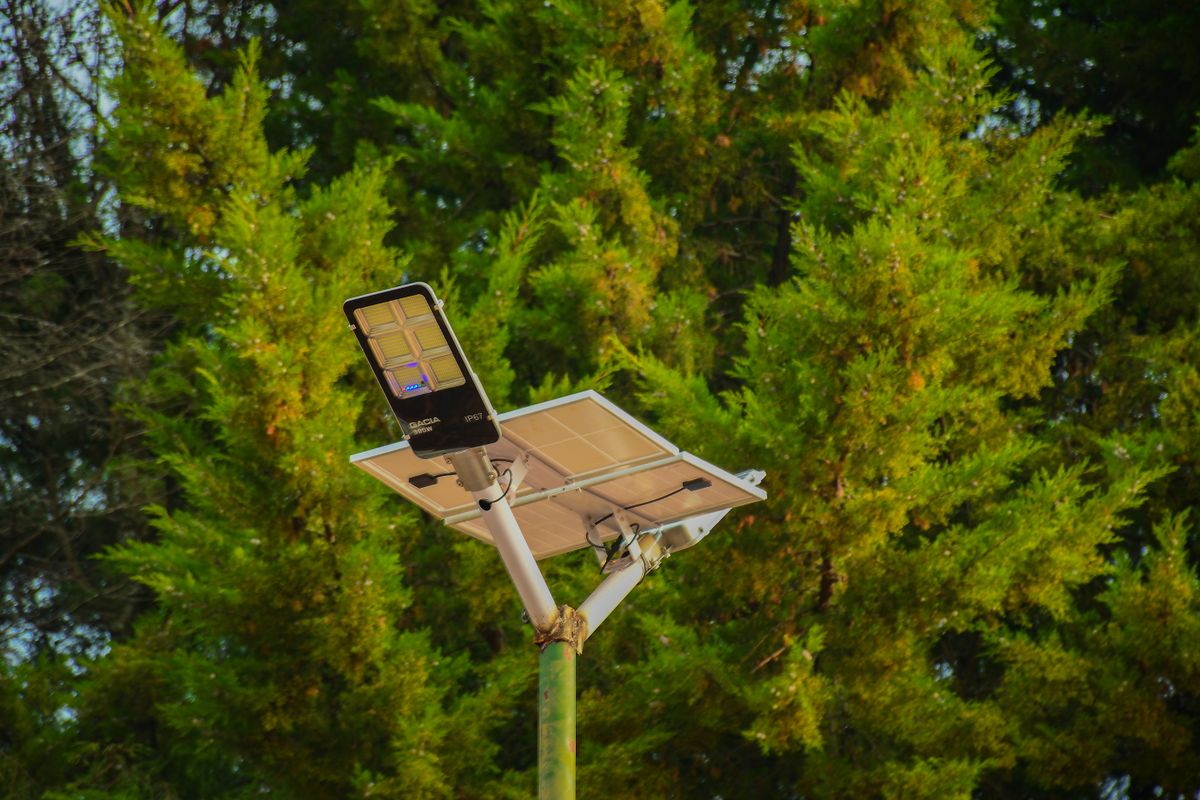
Photo by finix photographer on Pexels
- Shadow Elimination: Single hardwired floodlights create blinding glare and deep blind spots behind obstacles; multi-point smart solar lights eliminate dark zones entirely.
- Massive Cost Savings: Solar spotlights require $0 conduit trenching, $0 electrician labor, and $0 grid power, saving $500–$1,500 upfront.
- Optimal Panel Placement: Always tilt solar panels to ±5° of your local latitude (facing South in the Northern Hemisphere) and keep them clear of roof eaves and foliage shadows.
- Avoid Ambient Sensor Interference: Do not place solar spotlights directly under strong hardwired porch lights, which can trick the daylight sensor into turning off.
- Smart App Management: Update your mobile application to the Aidot app version 2.5.0 to manage brightness, color temperature (RGBTW), and automated security grouping.
In-Depth Decision Support Guide
Objective decision parameters comparing multi-point solar flexibility against high-voltage floodlight constraints across common US property layouts.
Best choice for
- Smart Solar Spotlights — Staggered multi-point setup (5–7 ft setback) provides continuous, glare-free border lighting with zero labor costs.
- Hardwired Floodlights — Continuous 120V grid power maintains extreme single-point brightness in areas with zero direct sun exposure.
- Solar panels would be positioned under permanent roof eaves receiving less than 2 hours of daylight daily.
- High-intensity hardwired security lights shine directly onto the solar spotlight photo sensor, forcing it to remain off at night.
- Low-Voltage 12V Landscape Lighting — Requires a buried wire and transformer, but offers lower-risk DIY wiring compared to 120V hardwired floodlights.
Recommended Smart Solar Lighting Solution
For homeowners seeking the optimal balance of outdoor security, app automation, and weatherproofing, the Linkind SL5C Smart Solar Spotlight stands out as the category leader. Featuring vibrant RGBTW color-changing LEDs, an IP67 waterproof rating, and intuitive Bluetooth/Wi-Fi control via the Aidot app (version 2.5.0), it allows you to build a sophisticated multi-point perimeter defense system in under an hour.
Real-World Property Defense Scenarios
Suburban Backyard with Wooden Privacy Fence & Storage Shed — Deploy a 4-pack or 8-pack of Smart Solar Spotlights placed 5–7 feet back from the fence line in a staggered pattern. This casts overlapping beam spreads behind the shed and along the fence perimeter, completely erasing intruder hiding spots without tearing up your lawn for wire trenches.
Long Rural Driveway Bordered by Trees — Position solar spotlights along sunny gaps in the driveway border, angling solar panels to ±5° of local latitude facing South. Use the Aidot app (v2.5.0) to group fixtures and set automated warm-to-cool white security timers.
Dark Side Yard Under Deep Roof Eaves — If roof eaves block direct overhead sunlight, mount solar spotlights in garden beds slightly further away from the house where daylight reaches the panels, then tilt the optical spotlight heads back toward the side-yard wall.
Practical lighting strategies for common US residential yard challenges.
The Hidden Costs and Failure Modes of Hardwired Systems
Traditional 120V hardwired floodlights have long been the default for security lighting, but they carry significant physical and financial failure modes. Installing hardwired lights along a perimeter fence line requires digging 18-inch deep underground trenches, running rigid PVC conduit, installing weatherproof junction boxes, and pulling high-voltage wiring back to a main circuit breaker panel. In most US municipalities, this work requires a licensed electrician and building permits, pushing total installation costs between $500 and $1,500+ for labor alone.
Beyond cost, hardwired lights suffer from a fundamental optical flaw: single-source glare. A high-lumen floodlight mounted on a single corner wall casts an intensely bright light directly in front of it, but creates long, dark shadow corridors behind sheds, bushes, and fence corners. These deep shadows serve as blind spots for trespassers.
The Multi-Point Advantage of Smart Solar Spotlights
Modern smart solar spotlights solve these coverage gaps through distributed multi-point lighting. Instead of relying on one blinding 2,000-lumen light source, deploying a multi-pack of solar spotlights allows homeowners to place fixtures every 10 to 15 feet along a perimeter. Setting each light 5 to 7 feet back from the target wall or fence generates the ideal optical beam spread, ensuring overlapping fill light that erases dark blind spots completely.
Because smart solar spotlights operate on integrated high-efficiency solar panels and lithium batteries, they require zero electrical trenching, zero permits, and zero ongoing utility costs.
Critical Charging Rules: Preventing Solar Panel Starvation
To ensure your smart solar spotlights operate reliably throughout the night—even during short winter days—you must prevent the two primary solar failure modes: panel shadowing and sensor interference.
Next-Gen Security Automation via App Control
Upgrading to smart solar lighting introduces capabilities impossible with standard hardwired floodlights. By pairing fixtures with the Aidot app (version 2.5.0), homeowners can group multiple spotlights into security zones, customize brightness levels, fine-tune color temperatures across the RGBTW spectrum, and sync lighting scenes. Built with an IP67 waterproof rating, fixtures like the Linkind SL5C remain completely sealed against driving rain, heavy snowfall, and dust, providing robust year-round security defense.
Further Technical Resources
Explore technical guides to optimize your home's outdoor solar lighting infrastructure:
- How to Position Smart Solar Spotlights to Eliminate Perimeter Dark Spots
- Linkind SL5C Smart Solar Spotlight: Aidot App Setup & Charging Troubleshooting
- Smart Solar Spotlight Buying Guide: Selecting the Right Pack Size for Your Property
- Staggered Pathway Lighting Layout Strategy
- IP67 Waterproof Rating Outdoor Solar Lights Guide
Frequently Asked Questions
Clear answers to essential homeowner questions regarding solar spotlight security performance and installation.
Cover photo by Marius-Laurentiu Butan on Pexels.