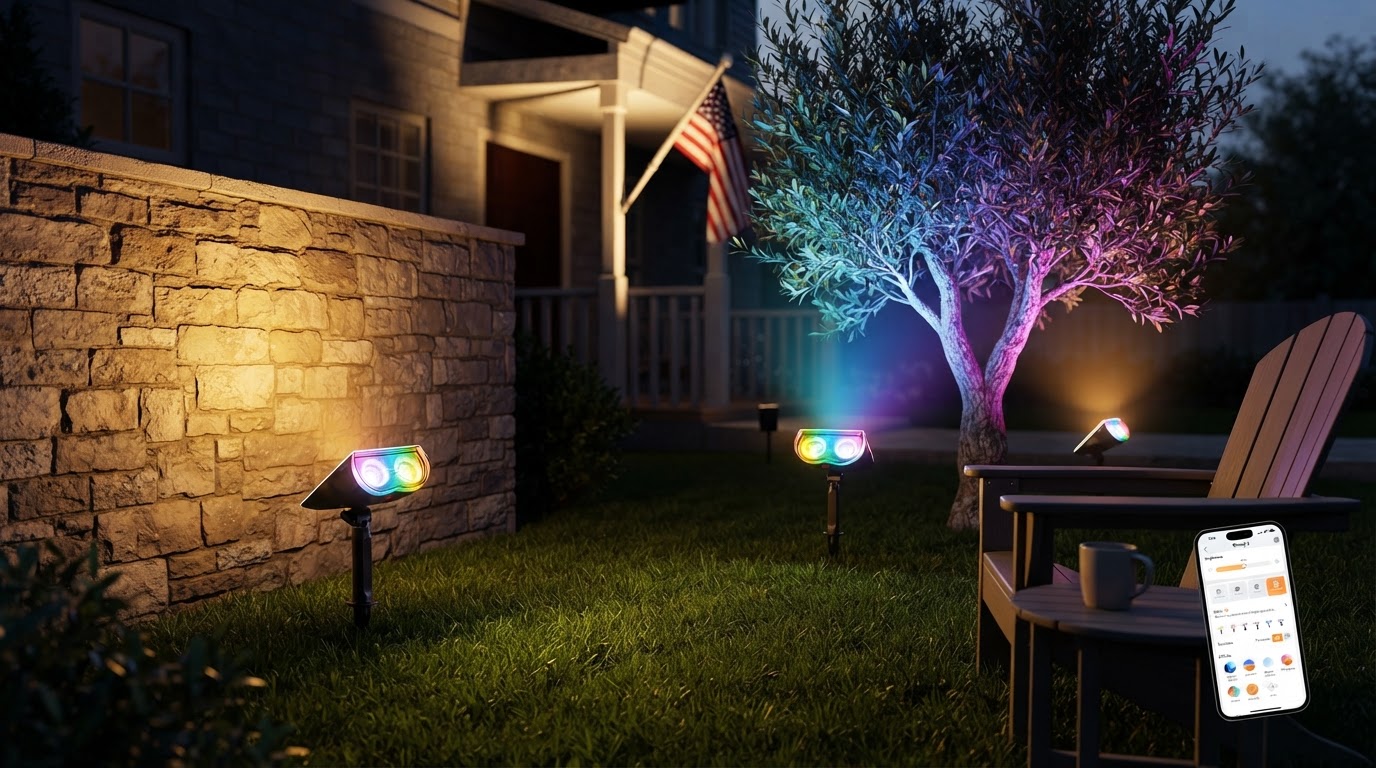
Linkind SL6C Discount Challenges Smart Solar Spotlight Value
 Maya ChenContributing Editor
August 14, 2026 — Amazon has initiated a significant price cut on the Linkind SL6C Outdoor RGB Solar Spotlight, reducing the unit to $15.99 for Prime members. This aggressive pricing strategy targets the entry-level smart landscaping market by offering dual USB-C and solar charging capabilities at a 50% discount.
The conventional wisdom says that a $16 price point makes this a low-risk upgrade for any yard. However, the technical reality suggests otherwise. According to Slickdeals.net, the $31.99 list price is slashed only after applying a specific promo code, and the deal is restricted to Prime members or orders over $35. Run the math: for a standard staggered path lighting approach, a homeowner requiring eight units must still navigate specific firmware requirements to ensure these devices don't become offline bricks. Performance is tethered strictly to the Aidot app, which must be updated to version 2.5.0 to function as advertised.
Photo by San Photography on Pexels
Here's the part nobody talks about: the efficiency of these units is entirely dependent on geographical precision rather than hardware cost. While the SL6C adds USB-C charging, the Smart Solar Spotlight SL5C remains the benchmark for durability with its IP67 waterproof rating. According to Slickdeals.net, the SL6C offer includes free shipping, but this does not mitigate the installation labor. Users often ignore that in the Northern Hemisphere, the solar panel tilt must be set at ±5° from local latitude to achieve the advertised charge cycles. Failure to avoid shadowed areas or proximity to competing strong light sources will render the dual-charging feature moot.
Expert tip: When installing the SL5C or SL6C, place the fixtures exactly 5-7 feet from objects. This specific distance is required to maximize the RGB color-changing spread without losing luminosity to atmospheric scattering or ground absorption.
I'll change my mind when long-term testing proves the internal lithium-ion cells can survive three consecutive winters without the USB-C tether. Until then, the discount reflects the volatility of the hardware, not a breakthrough in solar efficiency.