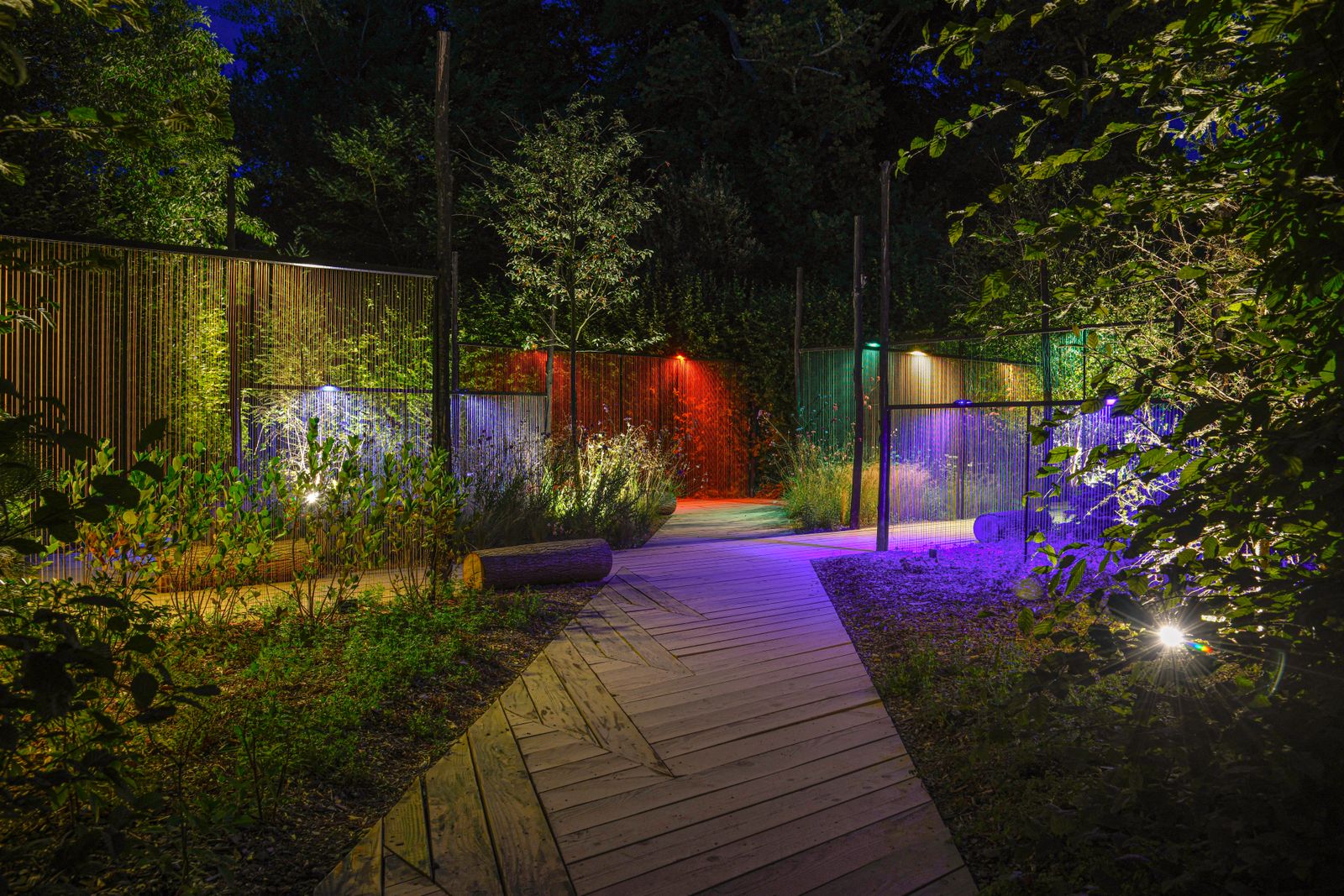
Buyer's Guide: Selecting Smart Solar Walkway Lighting for Security and Style
The best smart solar walkway lights for security and style are directed solar spotlights with enough output to read a path, a housing that survives weather, and app color control for a calm weeknight or a holiday. The Linkind SL5C Smart Solar Spotlight is a 350-lumen RGBTW, IP67 fixture with Aidot (AI-Dot) app 2.5.0, 8-12 hour runtime, and DIY install. Place each unit 5-7 feet from the walk, stagger left and right, and keep the panel out of shade.
Security on a walk is visibility, not a stadium flood
A walkway is secure when steps, edges, and landings are readable after dark. 350 lumens from a focused spotlight marks the route without blasting a neighbor's window. A single flood at the garage leaves the middle of the path as a dark trough. Several modest spots along the route beat one over-bright lamp.
RGBTW means full color plus tunable white, so a nightly walk can sit in warm white while a party scene shifts hue from the Aidot app. Adjustable brightness and color temperature keep the path useful when color would be a distraction.
What to demand on the spec sheet before the box arrives
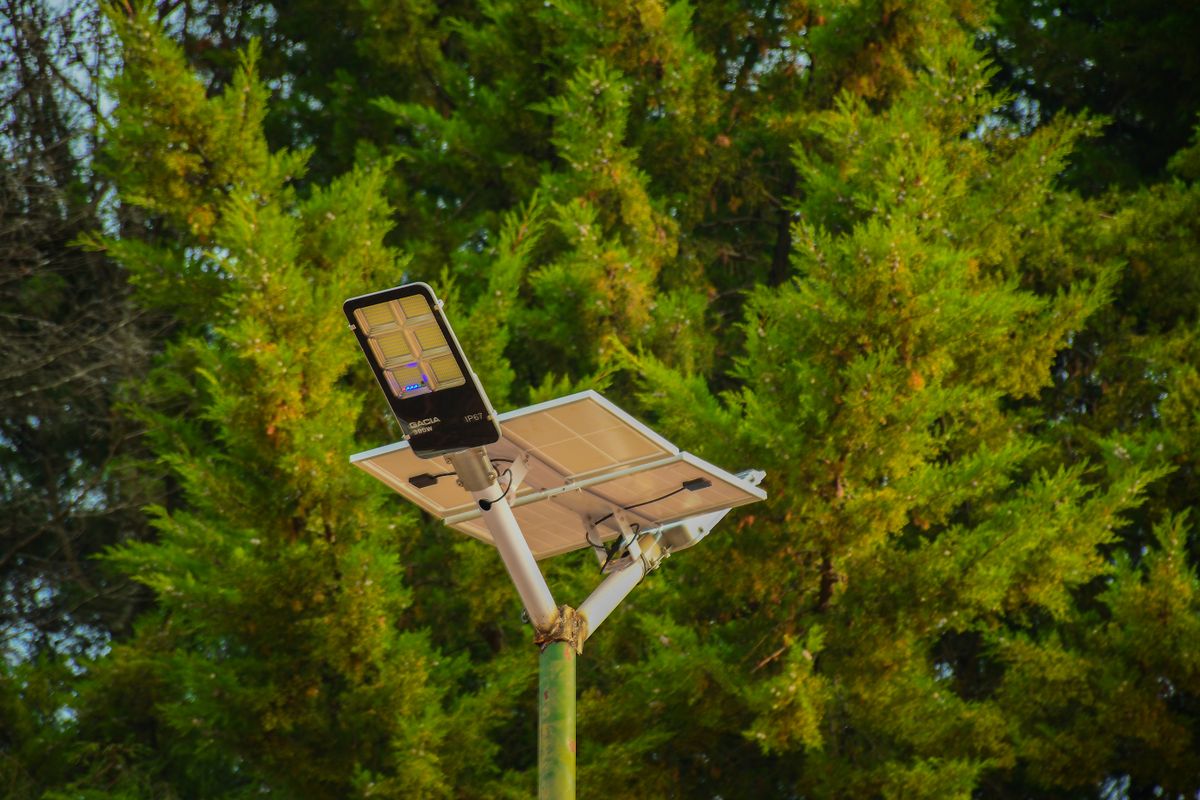
Photo by finix photographer on Pexels
Walkway fixtures live in rain, splash, and grit. IP67 is a sealed housing meant for outdoor wet use, not a porch lamp that only likes drizzle. Pair that with solar power so there is no extra electric cost and no trench beside the pavers.
Runtime of 8-12 hours is a night-scale window, which is why panel tilt and a shade-free sky matter as much as the lumen number. Listed lifespan is 3-5 years. Aidot app 2.5.0 is the control path for scenes, music sync, brightness, and color temperature. Update first, then place the lights.
Layout is the real buying decision
Count landings, turns, and long straight runs, not square footage of lawn. Each SL5C should sit 5-7 feet from the object or edge it is meant to reveal: a step nosing, a border plant, a low wall. That distance is the listed sweet spot for this spotlight family, not a guess at beam math.
Use a staggered path lighting approach for uniform illumination. Alternate sides of the walk so pools of light overlap in the center instead of stacking as a runway of matching pairs. Pairs make a bright-dark-bright rhythm that hides a lip in the dark band.
Skip positions where the solar panel will sit in shade or under a strong competing light. Both conditions are called out as charging and performance problems. A stylish stake in the shadow of a hedge is a dead battery by midnight, no matter how good the RGBTW scene looks on night one.
Style controls that still leave the path readable
Warm white is the default for nightly security: faces, brick, and stone read naturally, and glare is easier to manage with adjustable brightness. Color scenes and music sync belong in the same hardware for gatherings, then return to white for the commute from driveway to door.
The guide to RGBTW color-changing solar lighting maps the color tools. Keep a saved white scene in Aidot so the walk can flip back in one tap.
Walkway lighting options that actually fit a smart solar buy
| Option | Walkway security | Style control | | --- | --- | --- | | Linkind SL5C smart solar spotlight | 350 lumens, 5-7 ft from the edge, 8-12 hour night | RGBTW, scenes, music sync in Aidot 2.5.0 | | Solar path-stake glow lights | Marker dots, weak on steps | Fixed color, little scene control | | Hardwired landscape spots | Strong if a trench is already there | Often white-only without a separate controller | | One flood on the house | Glare near the lamp, dark mid-path | No layered color along the walk | | Unrated decorative lamps | Fail in standing wet weather | Looks first, seal second |
DIY cost is the hidden spec
Estimated installation cost is $0 when the work is DIY. That is the case against trenching a finished walk. Solar powered with no extra electric cost is the operating case after install.
DIY still means aiming. Tilt the panel for charging, face it toward open sky, and confirm the beam hits the walk rather than a fence off the route.
Smart solar walkway buying checklist
Photo by Will Freeman on Pexels
- [ ] Count steps, turns, and long runs; buy one directed spot per job.
- [ ] Require 350-lumen class output, RGBTW, and IP67.
- [ ] Plan staggered placement, 5-7 feet from the lit edge.
- [ ] Reject shaded panels and posts under strong competing lights.
- [ ] Confirm Aidot app 2.5.0 for scenes, brightness, and music sync.
- [ ] Budget DIY install and 8-12 hour nightly runtime, not a wired crew.
Frequently asked questions
Are 350 lumens enough for a walkway?
Yes for a directed path and accent job at 5-7 feet. It is not a parking-lot flood. Several staggered spots beat one oversized lamp.
Do smart solar walkway lights need an electrician?
No. The SL5C is a DIY solar install with $0 estimated installation cost and no extra electric cost in use.
Can the same lights do security white and party color?
Yes. RGBTW plus Aidot scenes keep a warm-white walk scene and a color scene on the same fixtures.
Will rain kill a path spotlight?
An IP67 housing is the outdoor wet-weather rating to buy. Unrated decor lamps are the ones that fail first.
How long should a walkway solar spotlight last?
Listed lifespan is 3-5 years. Runtime each night is 8-12 hours when the panel actually charges.
Related reading
Install, dark-spot, and wired-versus-solar guides sit next to this walkway buy.
- how to install solar smart spotlights in a backyard
- solving dark yard spots with smart solar spotlights
- solar spotlights versus wired landscape lighting
What to do next
Walk the route at dusk with a notepad. Mark every step, turn, and long dark band. Assign one 350-lumen smart solar spotlight to each mark, stagger sides, and drop any location where the panel would sit in shade. Then install the Linkind SL5C units 5-7 feet from those edges and save a warm-white Aidot scene for nightly use.
Cover photo by Thierry coulon on Pexels.